
In the wake of huge events, after them and before them, physical details– they spasm for a moment–they sort of unlock, and when they come back into focus, they suddenly coincide…in a weird way.

Pontypool (R) 96 min. Directed by: Bruce McDonald. Written by: Tony Burgess. Starring: Stephen McHattie, Lisa Houle, Georgina Reilly, Hrant Alianak, Rick Roberts. Cinematography: Miroslaw Baszak. Original music by: Claude Fossey.

One winter morning in Pontypool, Ontario, persnickety shock-jock Grant Massey arrives at work and heads into the local radio-station (in a church basement) where he meets his grudging work-force made up of grousy producer Sidney Briar, and production-assistant Laurel Ann. Massey is depressed by the encroaching winter dark, Briar agitated by Grant’s on-air antics, and Laurel Ann, an Afghan War vet, sits bemused in the midst of it.
And then, somewhere between updates by Ken Loney, the traffic advisor in his “Sunshine Chopper” (he’s just in his car on a hill) and an in-studio visit by ‘Lawrence and the Arabians’, a report comes in about an violent, escalating riot with the assailants “pulling people to the ground with their teeth”. Massey springs into action, relishing the opportunity to stand at ground zero of a real news story. And while the characters are in the dark, the audience understands whats happening–zombies have come to Cananda.
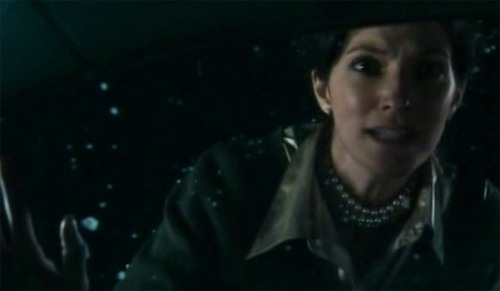
Bruce MacDonald’s Pontypool is a kick-in-the-head to the genre of the zombie horror film. The opening sections featuring the great Stephen McHattie as a piss-and-vinegar radio host are very effective in creating an unassuming, yet ominous atmosphere. When the on-air reports come through that a “herd” of people are actually biting and rending their victims I expected the zombies to roll through the town and rip their way into the station where Grant and co. would fight them off with various weapons.
What is ultimately surprising about Pontypool is that it doesn’t go that way. Instead of gallons of gore and a rote action plot that features hordes of made-up actors trundling after a small group, Pontypool remains inside of the radio station. The rapidly increasing epidemic of violent, mindless attacks is not visualized but instead comes to us almost completely through the on-air transmissions that Massey and his team get from observers.

We hear Ken Loney, terrified and traumatized, recounting an assault on a dentist’s office; “I’ve seen things today that will ruin the rest of my natural life, Grant.” The BBC gets in-touch with Massey and wants to know whats happening in Pontypool. A coded message is translated, and one of the major pieces says “Avoid the english language.” The most unsettling bit involves Loney’s phone recording of the infant screams emanating from one of the dying infected.
Massey has a near on-air breakdown, but quickly recovers and tries to bring his little gang together, struggling to understand the nature and cause of this new terror. As the film advances, the reality of what is happening is brought to light, and for one of the first times in recent memory there is a truly original thought at the center of a zombie pic. Combining the best parts of science fiction, linguistic theory, and psychological thrills, Pontypool imagines the end of the world as an internal deterioration that begins in the human mind and tears its way outward, spiraling into the kind of devestation that is physically eating its way through this small town.
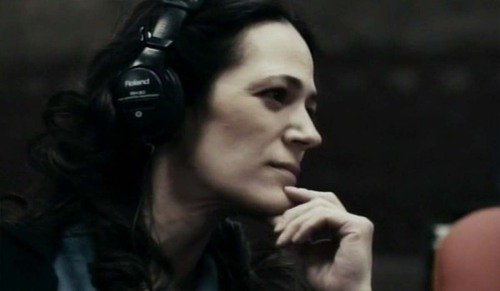
Good horror films are hard to find, but Pontypool isn’t just good, its great. It sneaks up on you, lulling you in with the grizzled, comforting tones of Stephen McHattie’s voice and the dreary environment of the radio station basement. Then, much like the Mercury Theater recording of War of the Worlds in 1938, the film uses words and the dark spaces of human imagination to create and nurture its terror. The script is taut and intelligent, doubling back on itself in ways I won’t reveal here, and for a large part of the film the only visual images we have to go on are the craggy, moon-like surfaces of McHattie’s face, his eyes staring wide in horror as he keeps the only weapon he has (his mouth) firing off at an enemy he cannot see.
In fact, McHattie is Pontypool’s secret weapon; he’s the guiding force that leads us through the film’s plot, and he’s also the picture’s emotional center. In the final third, when it becomes apparent that the nature of the infection is something Massey himself might actually be capable of combatting, he transforms into Pontypool’s determined hero. As new, Twilight Zone-esque revelations make their way into the radio station, McHattie keeps the film grounded in a sort of folksy, small-town reality.

There is a germ of a real and intriguing idea at the heart of Pontypool. Adapting his own book, Pontypool Changes Everything, Tony Burgess takes the expansive scope of the novel (it followed characters all over town, sometimes from their zombified POV) and discards it, choosing a small, claustrophobic setting and a handful of characters who experience the film’s event from across the gulf of the airwaves.
Bruce MacDonald takes that script and makes it as charged and fearsome as George Romero’s original Night of the Living Dead. There are moments of incalculable dread, mostly dealing with people repeating segments of their own sentences in an attempt to wring understanding from them.What follows these ‘broken record’ moments are the gruesome attacks that create the zombie atmosphere.
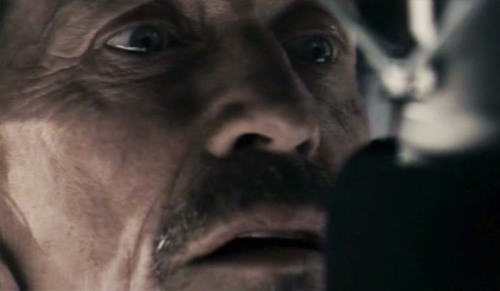
And yet, there is a great wit and humor to Pontypool. Ken Loney checks in from time to time with reports that are ever-increasing in their desperation; his last broadcast starts with “This is Ken Loney, reporting from inside of an empty grain silo!” Earlier, before things go south, Massey announces the snow-storm as a “big cold, white, dark, dull, empty, never-ending, blow-my-brains out, seasonal effective-disorder, kill-me-now, weather front… that will last all day.”
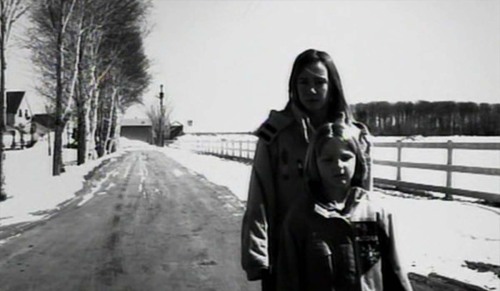
Massey never loses his hang-dog determinsim, even in the face of the apocalypse, taking the time to read all the obitiuaries, as he would on any other morning. Now, though they reach out over several long minutes, documenting the attacks as they have occured to the individual town residents. Over McHattie’s sad narration, we see black and white footage of all those now-departed families; its a powerful moment and extends beyond the simple aims of a generic horror film.
Pontypool is not a flawless film, but its power is such that we don’t notice those flaws; instead, we are delighted to find something compelling and thoughtful. It works on several layers, but primarily as an entertainment that doesn’t limit itself. Like Welles, who wanted to scare people, make them think, and allow them to breathe relief and chuckle at their own nervous fear, Pontypool isn’t aiming at a demographic; it sends its distressing message and mind-bending theories out there into the cultural atmosphere and waits to see who they will infect.
Consider me contaminated, because Pontypool feels like a horror masterpiece. And for any of the rest of my fellow infected, where can we all get t-shirts that say “Sydney Briar is Still Alive” ?
 Cinematropolis
Man, I loved this movie so much and loved it a little more knowing that it’s Canadian. I keep reading reviews, all positive, as they come in for this movie and I hope it continues to ‘infect’ the world.
“Hi Jonah Long time caller first time listener.” Oh god I hate call in radio talk shows.
So when does this interesting movie come out? and thanks for the info because I’ve never heard of this movie but that’s not a surprise.
Man, I want to see this movie. It reminds me of 9-11. I was driving my girlfriend to the airport listening to Howard Stern, when the first plane hit, followed by the second plane and the realization something major was going on.
This sounds like the zombie version of that day.
That’s interesting Conti. I was listening to Stern also that morning.
I’m not a huge Stern fan, Xi. But that day I think was his finest hour. Him and his crew sounded just like regular people, completely unsure what the fuck was going on but trying to find out. The difference between them and the mainstream media and big networks was they admitted they had no clue and didn’t pretend like they were going to come up with something later.
BTW – is Xiphos0311 and Xiphos both you, or is there like a DGDB imposture of you here?
I have not heard Stern in years even before he went the SATCOM route I was out, but I agree that the part of it I heard that day they did a good job. As soon as tower 2 got hit I was on my bike racing in to work(I had the day off for some reason but forgot what it was). That was a day of shit meet fan.
Both names are me. When we were setting up the WOTM I was having having trouble with the Xiphos name I couldn’t get to work so I made a new one with the MOS designator.
Some of the New Moon cultists over on that page probably hate me enough to go the Danny imposer route. They are desperately begging Jonah to ban me.
No kidding about the New Moon cultist. I actually was DEFENDING New Moon over at Koutchboom’s review and one of them attacked me. They see anything that doesn’t fit their interpretation of that film as an attack.
To be fair I did wade into their magical kingdom throwing Texas hay makers just for the fun of it but still YIKES! I left the obvious young ones alone but I did hook two really far gone cultist and what I believe to be Mormons. I would have been really fun to go AICN war on them but I abide by Jonah’s desire to keep this place clean.